
Finding the Right Bow Length
What bow length means and where to find it
The measurement runs from one limb tip to the other, following the curve of the back of the bow rather than a straight line between the tips. The value follows the AMO standard, now ATA, and is always given in inches. Because every manufacturer measures the same way, you can buy strings and limbs without guesswork.
String length follows directly from bow length. The string is 4 inches shorter than the bow, so a 68 inch bow needs a 64 inch string and a 62 inch bow needs 58 inches. That difference produces the brace height the bow was designed around.
How you measure that brace height on the strung bow and adjust it through the string is covered in how to assemble a recurve bow. This article is about choosing the right bow length, that one about putting the bow together.
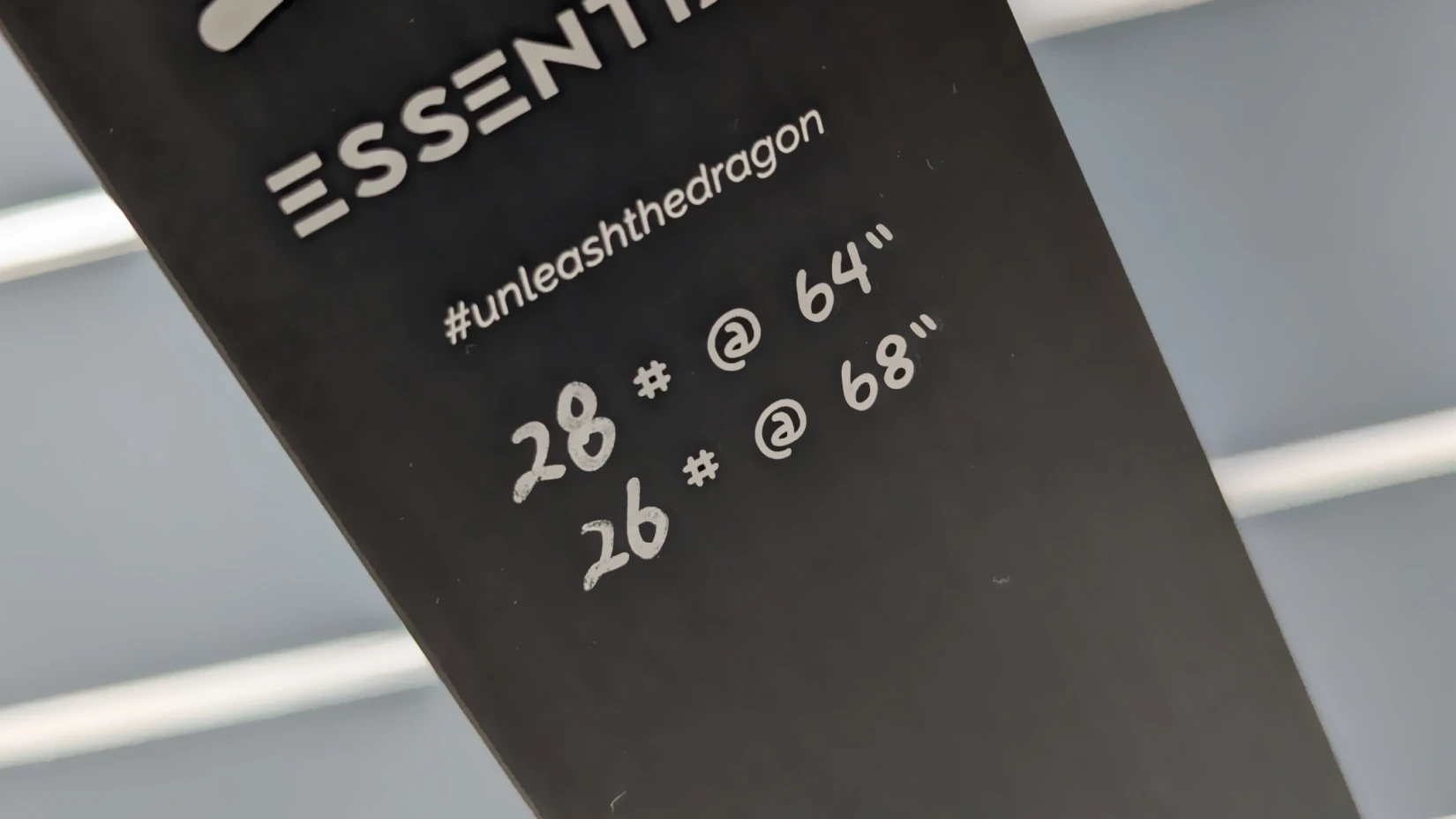
You will usually find the number on the inside of the lower limb. More than one figure is printed there, which causes regular confusion. Alongside bow length sits the draw weight, and on ILF limbs it appears twice, because the same limb gives a different weight on a 21 inch riser than on a 25 inch riser.
Your draw length is the starting value

Draw length describes how far you actually pull the bow. It depends on your anatomy, mostly on your arm span, and it is the only value that lets you derive bow length properly. Two archers who both stand 5 ft 9 in (175 cm) can draw anywhere from 27 to 30 inches depending on arm length.
For a first estimate, measure your arm span fingertip to fingertip and divide by 2.5. An arm span of 71 inches (180 cm) gives roughly 28.3 inches (72 cm) of draw. A drawn arrow measured at a club or pro shop is more accurate. The measurement runs at full draw from the deepest point of the grip, the pivot point, to the nock groove, plus 1.75 inches. On traditional bows the front edge of the shelf is the reference point instead.
One factor many archers underestimate is the anchor point. Anchoring at the corner of the mouth shortens your draw by around an inch compared with anchoring behind the jaw. If your anchor is still changing, pick a length that leaves some room to grow.
Why there are two recommendations
A longer bow gives a shallower string angle. The string sits more comfortably across your fingers, the bow stays calmer through the shot and it forgives an untidy release. Target archers therefore favour long bows, since they shoot known distances and want repeatability.
In the field the priorities flip. On a 3D course or when hunting, a compact bow avoids catching branches and works from kneeling positions, and the steeper string angle is the price you pay. Traditional recurves are built shorter anyway, with risers of 15 to 19 inches against 21 or 25 inches in the sport segment.
| Property | Short bow, 60 to 64 inches | Long bow, 66 to 70 inches |
|---|---|---|
| String angle at full draw | steep, pinches the fingers | shallow, comfortable |
| Forgiveness | low, every release error shows | high |
| Stability through the shot | less settled | very settled |
| Arrow speed at equal draw weight | slightly higher | slightly lower, 2 to 5 fps |
| Handling in the field | agile, good on a course | bulky among branches |
Bow length for sport and Olympic recurve bows
This is where fitting matters most, because at longer distances every bit of spread becomes visible. The table applies to take-down bows with an ILF fitting and to Olympic setups as used under World Archery rules.
| Draw length | Recommended bow length |
|---|---|
| up to 22 inches (56 cm) | 58 inches |
| 22 to 24 inches (56 to 61 cm) | 62 inches |
| 24 to 26 inches (61 to 66 cm) | 64 to 66 inches |
| 26 to 28 inches (66 to 71 cm) | 66 to 68 inches |
| 28 to 30 inches (71 to 76 cm) | 68 to 70 inches |
| 30 inches and above (over 76 cm) | 70 to 72 inches |
68 inches suits more adult archers than any other size and covers draw lengths from roughly 26 to 29 inches comfortably. Within your row, the longer option is the safer one. One step up, not two, because too long carries a cost as well, see how to spot the wrong length.
The practical advantage in the sport segment comes from the ILF system, where a riser combines with short, medium and long limbs. A 25 inch riser gives 68 inches with medium limbs and 70 inches with long limbs, so a change of length means a new set of limbs. If you misjudge the length or your anchor point shifts, you replace the limbs instead of the whole bow. Our range is in the bows category.
Bow length for traditional and hunting bows
Our traditional bows run noticeably shorter, typically 58 to 64 inches and most often 60 to 62 inches, and they depend less on the archer's size than sport bows do. The values below show which draw length still works cleanly at a given bow length. Treat them as an upper limit rather than an ideal for target shooting.
| Draw length | Workable traditional length | Note |
|---|---|---|
| up to 28 inches | 62 inches | at 28 inches this is the limit, the bow works at the top of its range |
| 29 inches | 64 inches | 66 inches is calmer for target work |
| 30 inches | 66 inches | 68 inches adds comfort here |
| 31 inches | 68 inches | 70 inches is the better call at this draw |
| 32 inches and above | 70 inches | anything shorter gets risky |
Two points matter here. First, design shifts the limit. Deflex geometries with softened limb angles carry a 30 inch draw even at 60 inches of bow length without stacking up. The manufacturer states the maximum draw in the data sheet, and that figure overrides any table. Second, the maximum workable value is not the pleasant one. Shooting traditional on a target face with a 29 inch draw works better at 64 inches than at 62.
Longbows, hybrid bows and compounds
Longbow length roughly follows the archer's height, and the bow tends to stand about as tall as its owner. English longbows run 70 to 78 inches, American flatbows 68 to 72 inches. Hybrid bows, sitting between longbow and recurve, measure 64 to 68 inches.
Compound bows follow a different logic. The figure quoted is the ATA length, the distance between the cam axles. Hunting models run 30 to 34 inches, target models 40 to 48 inches. Your height barely matters, because draw length is set through modules in half inch steps. That setting does need to be exact, since the wall stops the draw hard and you cannot shoot over or under it.
If you do not know your draw length yet
Height works as a first reference, for instance when picking up club loaner equipment. These values apply to sport recurve bows.
| Height | Bow length |
|---|---|
| 3 ft 11 in to 4 ft 5 in (120 to 135 cm) | 58 inches |
| 4 ft 6 in to 4 ft 11 in (136 to 150 cm) | 62 inches |
| 4 ft 11 in to 5 ft 3 in (151 to 160 cm) | 64 inches |
| 5 ft 3 in to 5 ft 6 in (161 to 167 cm) | 66 inches |
| 5 ft 6 in to 5 ft 9 in (168 to 175 cm) | 68 inches |
| 5 ft 9 in and taller (from 176 cm) | 70 inches |
With children and teenagers, growth comes into play. A take-down bow with an ILF fitting is the relaxed answer, because you start with short limbs at low weight and move to longer limbs at higher weight later while the riser stays.
| Age and height | Bow length | Draw weight |
|---|---|---|
| 6 to 8 years, up to 3 ft 11 in (120 cm) | 54 inches | 8 to 12 lbs |
| 8 to 10 years, 3 ft 11 in to 4 ft 5 in (120 to 135 cm) | 58 inches | 10 to 14 lbs |
| 10 to 12 years, 4 ft 5 in to 4 ft 11 in (135 to 150 cm) | 62 inches | 12 to 18 lbs |
| 12 years and older, over 4 ft 11 in (150 cm) | 64 to 66 inches | 16 to 22 lbs |
Reading length and draw weight together
String angle comes purely from the ratio of bow length to draw length. Draw weight does not change that angle, it decides how strongly you feel it. The same geometry presses harder on your fingers at 45 lbs than at 25 lbs.
That does not make short and heavy a bad pairing. Traditional and hunting bows are built exactly that way, compact and often at 40 to 50 lbs or more, and it works because the limbs are designed for that range. A 60 inch bow at 45 lbs is unremarkable in the traditional world. What matters is the maximum draw in the data sheet. Only when you pull past it do stacking and heavy load add up, and then both land in the same place, your fingers and your shoulder.
Starting out in target archery works the other way round. There, draw weight is not a performance figure but the limit at which you can hold full draw steady for ten seconds. The values below apply to sport recurve bows for beginners and are not a benchmark for traditional hunting bows.
| Archer | Draw weight on a sport recurve |
|---|---|
| Children, 8 to 12 years | 10 to 16 lbs |
| Teenagers, 13 to 17 years | 16 to 20 lbs |
| Adult women | 16 to 24 lbs |
| Adult men | 20 to 26 lbs |
One detail decides how to read that number. The weight printed on the limb applies at a 28 inch draw under the AMO standard, and the real weight shifts by 1 to 2 lbs for every inch away from it. At a 26 inch draw, a limb marked 24 lbs delivers around 20 lbs. If you are torn between two weights, take the lower one and swap limbs after a few months.
How to spot the wrong length
The bow tells you fairly clearly when the length is off. Four signals point to a bow that is too short.
- Stacking: draw weight climbs disproportionately through the last third of the draw and the pull feels hard and blocked at the end. The bow is closing up because the limbs are working at their design limit.
- Finger pinch: the string angle turns so steep that the string squeezes your fingers together, which makes a clean release almost impossible.
- Hand shock: a distinct jolt into the bow hand after the shot shows that the system is out of tune or overloaded.
- Material fatigue: drawing a bow past its limit over time risks cracks in the limbs and, in the worst case, a sudden failure.
The opposite case exists too and gets mentioned far less often. A bow that is too long for your short draw never reaches its working range. The limbs do not bend far enough to release their full energy, and the shot feels sluggish. A long bow is also heavier and less handy in the field. That is why the advice is one step up within your row, not two.
Conclusion
Measure your draw length first, then decide whether you are shooting sport or traditional, and read the length from the matching table. For most adult target archers that means 68 inches, for traditional archers 60 to 64 inches. If you are unsure about your draw, take a drawn arrow to a club, or start with a take-down bow using an ILF fitting so a correction later costs you a set of limbs rather than a whole bow.
FAQs
What bow length suits a 28 inch draw?
For sport and Olympic recurve bows, 66 to 68 inches, with 68 inches the more common choice. Traditional bows still work at 62 inches with a 28 inch draw, but that is the upper limit there.
How long a string does a 68 inch bow need?
64 inches. The string runs 4 inches shorter than the stated bow length so the bow reaches its designed brace height. A 62 inch bow takes a 58 inch string.
How do I know my bow is too short?
Three signs give it away. Draw weight climbs hard at the end of the draw, which is called stacking. The string pinches your fingers because its angle is too steep. And you feel a clear hand shock after the shot.
Can I change bow length later?
On a take-down bow yes, on a one piece bow no. With a 25 inch riser, medium limbs give 68 inches and long limbs give 70 inches, so you only swap the limbs. One piece bows have a fixed length.
Does a longer bow need longer arrows?
No. Arrow length follows your draw length plus roughly 1 inch of safety margin, not the length of the bow. A 28 inch draw calls for 29 inch arrows whether the bow measures 64 or 70 inches.
Where is the bow length marked on the bow?
Usually on the inside of the lower limb. The draw weight sits there as well, stated for a 28 inch draw under the AMO standard. ILF limbs often carry two weight figures, one for a 21 inch riser and one for a 25 inch riser.