
Setting the Brace Height
What brace height is and why it has to stay put
String a bow and a gap opens up between the grip and the string. That gap is the brace height, and it tells you how much the bow is pre-tensioned.
Why it matters becomes clear from the chain of consequences. Brace height has a say in how much force acts on the arrow. Change it and the force changes, which changes arrow flight, which changes where your group sits. Your sight was set up at one particular brace height, and every mark on it applies to that setting alone.
Archery has plenty of variables you cannot control. Brace height is one of the few you can check with one look and one measurement. That is why it repays the effort, not because any single figure is magic, but because a figure that stays the same makes your shot repeatable.
How brace height comes about in the first place, out of the difference between bow length and string length, is covered in the article on bow length. That one is about choosing the bow, this one about the figure on the bow you already have.

Measuring the brace height
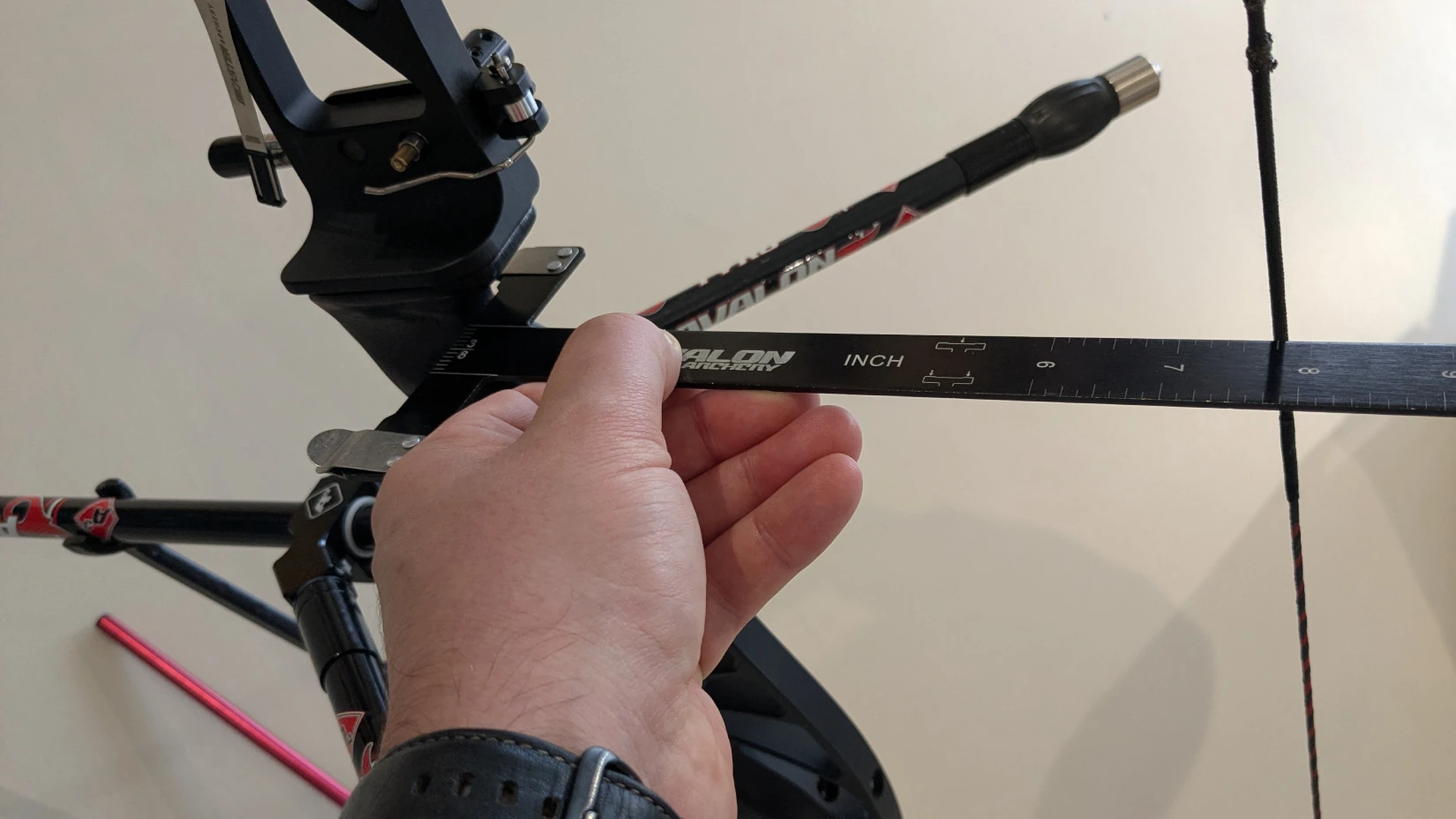
Measure with the bow strung, using a bow square. That is the small string gauge you also use for the nocking point, and its scale normally carries both inches and centimetres.
- Set the T-shaped end of the bow square against the deepest point of the grip.
- The arm carrying the scale then sits at a right angle to the string.
- Read the figure where the string crosses the arm.
Three conditions decide whether your reading is worth anything. Hold the bow by the riser so the limbs are unloaded and the bow is not resting on anything. Keep the bow square straight, because a tilt throws the reading off. And stay with one unit, either inches or centimetres. Plenty of archers work in inches, where the figures land on half steps and are easier to remember.
Write the figure down. Without a recorded target value the measurement does nothing for you next time, because you have nothing to compare against.
What brace height is right
On a recurve bow the usual range runs from 7.5 to 9 inches. There is no exact prescription, because your equipment and your shooting style both play a part. As a tendency, a short bow sits nearer the lower end and a long bow nearer the upper one. On a 70 inch bow you are therefore closer to 9 inches than to 7.5.
What governs is the recommendation for your bow. Manufacturers and experienced dealers give it for the combination of bow type, limbs and string in use. Treat that figure as the one to hold, and vary it only slightly.
One quirk goes with it. The figure is usually not printed on the bow but appears only in the product description. Ask for it when you buy and note it down while you still have it. With no experience of the model, the middle of the recommended range is the sensible place to start.
Which figure a manufacturer quotes for a given model shows up in that product description, including on our bows. The specification sits with the bow, what you do with it sits here.
A check that needs no manufacturer figure
If you can no longer find the recommendation, the bow itself will tell you something. The string should lie against the upper and lower limb for roughly 5/8 to 3/4 inch (1.5 to 2 cm) before it leaves the limb. Noticeably less contact means the brace height is too high, noticeably more means it is too low.
Adjusting the brace height through the string
Brace height is not adjusted at the bow but at the string. Twist the string in and it gets shorter, so the brace height rises. Twist it out and it gets longer, so the brace height drops.
- Unstring the bow and take the string off one limb.
- Twist the string the way you need, a few turns to begin with.
- Hook it back on, string the bow and measure again.
- Repeat until the figure is where you want it.
How much a single turn is worth cannot be quoted. There is no fixed figure for it, because string material, construction and length all come into it. Measuring after every step is therefore not fussiness but the only way through. Two or three rounds of that is entirely normal.
Two things tend to go wrong. If the brace height does not move despite the twisting, you have turned the wrong way or the string has untwisted itself as you hooked it back on. And a string that does not sit properly will work its way back over time, in which case the effort was wasted. After a few attempts you develop a feel for it.
If you find yourself twisting far past the manufacturer recommendation just to reach the range, the string length probably does not match the bow. A different string is the better answer than a heavily twisted one.
What changes with the brace height
A change never comes on its own, and it shows up on several levels at once. The table below shows how to tell where you stand.
| State | How you notice | What it means |
|---|---|---|
| Too low | The bow cracks on release, arrows creep upwards on the target face, the arrow leaves the bow untidily | More speed, but poorer arrow flight, heavier load on the limbs and a risk of string slap |
| Within 7.5 to 9 inches | Quiet behaviour, the string lies against each limb for 1.5 to 2 cm | A repeatable group, the arrow leaves straight |
| Too high | The sound on release turns duller, the group drops | More forgiving behaviour, at the cost of arrow speed |
Speed and where the group sits
A higher brace height raises draw weight slightly, because the shorter string loads the limbs more heavily at full draw. At the same time the distance over which the arrow accelerates gets shorter, and that shorter run counts for more. Hence the simple rule that more brace height means less arrow speed, and less brace height means more.
You see it on the target face. When brace height drops, more force reaches the arrow and the group climbs. When it rises, the group sinks. That is why arrows drifting with your technique unchanged call for a look at the brace height first.
Feel and sound
Brace height also changes how the bow feels. The lower it goes, the harsher the bow becomes on release, and the higher it goes, the more forgiving. You can hear it too. A low brace height makes the bow crack, a higher one sounds duller. On a recurve the difference is especially clear, because at a low brace height more of the string slaps against the limbs.
Go too low and the string goes slack at the front, and the arrow leaves just as untidily. It wobbles or fishtails instead of flying straight. We know that one well from advising customers, because anyone complaining about poor arrow flight nearly always has too little brace height.
Why not simply go lower for more performance
It is an obvious question, and the answer comes in two parts.
The first is safety. A very low brace height can let the string reach all the way to your wrist. At the same time the load on the limbs rises, and with it the chance of damage.
The second is accuracy. Your entire sight setting hangs on one brace height. Change it for a handful of fps and you have to shoot it all in again. What you gain in speed you pay for in repeatability, and in archery that is the harder currency. When in doubt, rather a little more brace height than too little.
When to measure again
Brace height does not stay where you set it. Four occasions belong in the routine.
- At every assembly: a look at the figure before the first arrow goes on.
- After your first shots: a new string stretches noticeably as it beds in, and the brace height drops with it.
- When arrow flight changes: particularly when the group starts creeping upwards.
- When the weather turns: rain above all works on the string and therefore on the brace height.
While you are there, check the bolts on the bow for a tight seat. An archer who has written the brace height down spots a deviation in seconds.
A few closing thoughts
Brace height gives you the best return on effort of any figure on the bow. Measuring takes ten seconds and it explains a whole row of problems that otherwise get blamed on technique. Measure it at your next assembly, write the figure down, and measure again after the first twenty shots. If it has moved, you now know what to do.
FAQs
What is brace height on a bow?
Brace height is the distance between the deepest point of the grip and the string, measured on a strung bow. It shows how much the bow is pre-tensioned and it influences arrow speed, arrow flight and where your group sits.
How do I measure brace height?
Set the T-shaped end of a bow square against the deepest point of the grip so that the arm carrying the scale sits at a right angle to the string, then read the figure where the string crosses the arm. Hold the bow by the riser so the limbs are unloaded and the bow is not resting on anything.
What brace height is right on a recurve bow?
The usual range runs from 7.5 to 9 inches, roughly 19 to 23 cm. Short bows sit nearer the lower end and long bows nearer the upper one. What governs is the manufacturer recommendation for your combination of bow, limbs and string.
How do I change the brace height?
By twisting the string. Twisting in shortens the string and raises the brace height, twisting out lowers it. How much a single turn is worth cannot be quoted in general, which is why you measure again after every step.
Why are my arrows creeping upwards on the target?
A common cause is a brace height that has dropped. More force then reaches the arrow, it flies faster and lands higher. Measure the brace height and compare it with the figure you noted before you start doubting your technique.
How often should I check the brace height?
At every assembly of the bow, after the first shots with a new string, when the weather turns and whenever arrow flight changes. A new string stretches noticeably at first, which lowers the brace height.