
Recurve vs. Compound Crossbow: Differences & Buying Guide
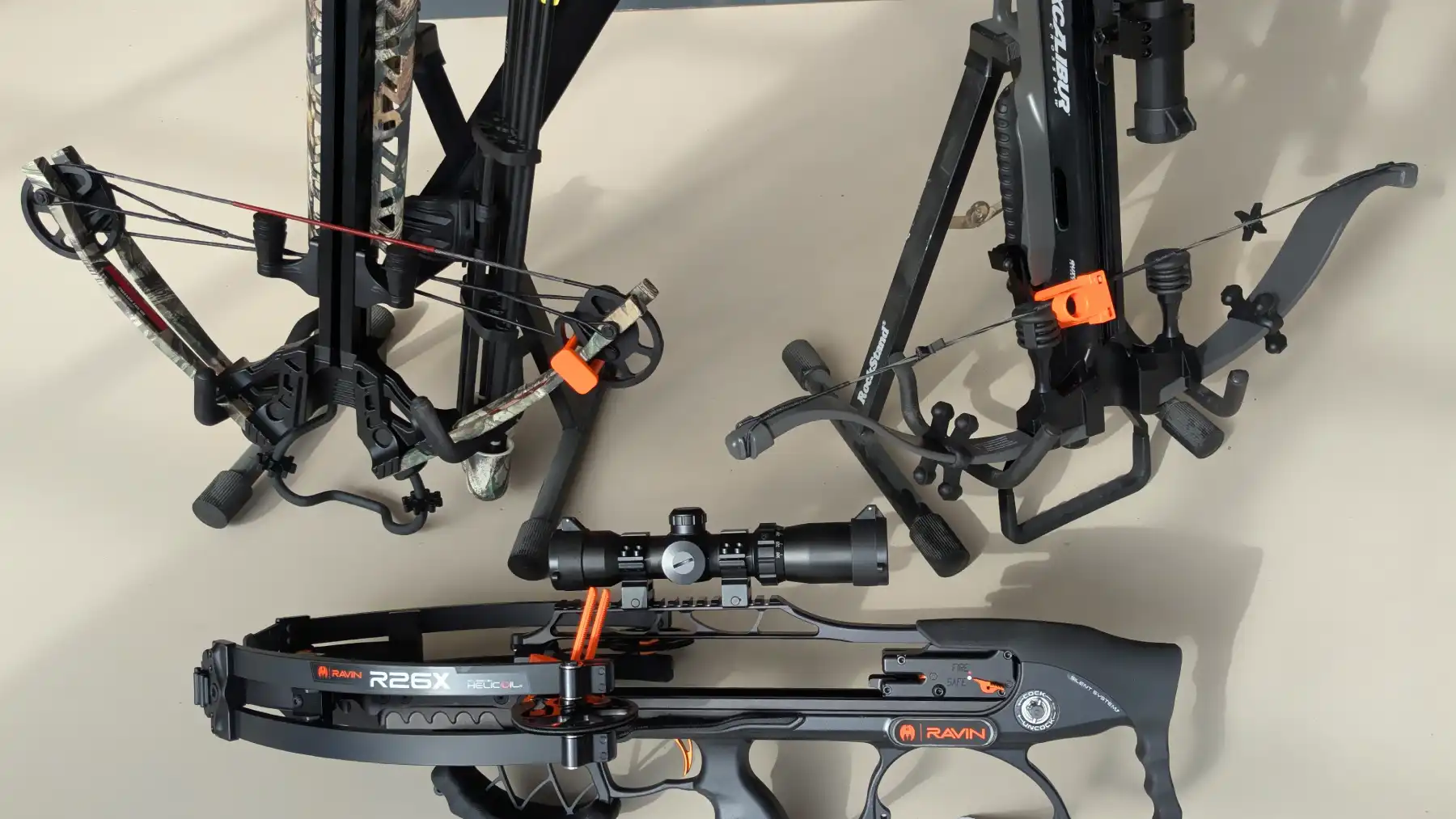
Shopping for a crossbow puts one decision in front of everything else, recurve or compound. The answer sits at the tips of the limbs. A compound crossbow carries cams there, eccentric wheels running on axles, plus cables that cross underneath the rail. That mechanism stores more energy at a given draw weight, so it needs less draw weight for the same bolt speed. A recurve crossbow skips all of it and consists of the limbs and the string that joins them.
Everything else follows from that. More mechanism means more performance and more parts that wear. Less mechanism means less performance and less that can fail. Which design suits you depends on which of those two trades you prefer.

Recurve or compound: the differences at a glance
Both types do the same job and differ in how they store energy and release it again. The table below lines up the points you actually notice in use.
| Feature | Recurve crossbow | Compound crossbow |
|---|---|---|
| Construction | Limbs and string, nothing else | Cams on axles, plus two cables |
| Cocking force at equal performance | Higher, because it takes more draw weight | Lower, because less draw weight does the job |
| Performance at equal draw weight | Lower | Higher, hence the flatter trajectory |
| Wear parts | Essentially the string | String, two cables, cams, axles |
| String replacement | Doable yourself with a stringer | Usually needs a crossbow press |
| Servicing | Low | Higher, cables and cams come on top |
| Entry-level range | Limited | Wide |
Notice that neither column wins outright. The compound pulls more performance out of less draw weight, the recurve gives you less trouble over the years. That is exactly why both designs have coexisted for decades.
How does a compound crossbow work?
A compound crossbow looks futuristic at first glance. Prominent wheels at the limb tips, several cables and a string crossing and joining each other. What looks complicated follows a simple principle.
As you cock the crossbow, the string sets the cams in motion. The cables attached to those cams pull on the opposite limb, where their other end is anchored. That is the block and tackle effect. It reshapes the force curve across the cocking stroke, and the rest hangs on that.
On the shot the sequence runs backwards. The loaded limbs pass their energy through the cables to the cams. The block and tackle effect that started during cocking now acts on the string, and the string accelerates the bolt.
What the mechanism actually buys you
- More energy at the same draw weight: Force builds earlier and stays high for longer across the stroke, so more energy ends up in the limbs.
- Less draw weight for the same performance: If you are after a particular bolt speed, you get there with a lower draw weight than a recurve crossbow would need. That is the part you feel while cocking.
- Flatter trajectory: The bolt drops less on its way to the target, which makes aiming easier and small range errors cheaper.
For a sense of scale, take two common compound models. The manufacturer lists the X-BOW FMA Scorpion at 175 lbs and 375 fps (about 114 m/s), and the EK Archery HEX-400 at 210 lbs and 400 fps (about 122 m/s). Both figures are manufacturer specifications rather than our own measurements, and speeds are usually quoted with a set bolt weight that may differ from what you end up shooting.
How does a recurve crossbow work?
The recurve crossbow is the older design and matches the picture most people carry in their heads. It does without the cam system and therefore without the wheels at the limb tips. There are no extra cables either. What remains is the pair of limbs and the string that connects them.
You cock it with a cocking aid, which bends and loads the limbs. No cam system sits in between. The limbs load through the string alone and store all of the energy. On the shot they hand that energy straight to the string and from there to the bolt, with no detour through wheels and cables.
Leaving those parts out is what makes a recurve crossbow easier to live with, because there is simply less that can wear. What you give up is the mechanical help while cocking. For comparable performance the draw weight sits higher, and you feel that on every single cocking stroke.
Anyone shopping specifically for a recurve crossbow ends up at Excalibur sooner or later. The Canadian manufacturer has committed to this design, while most other brands stock mainly compound models.
How big is the difference when cocking?
This is the question that comes up most often, and the answer is calmer than expected. Hardly anyone cocks by hand anyway, because one limb easily ends up loaded more than the other, which shows up as an inconsistent group. So you use a cocking aid, and that shifts the whole calculation.
- Rope cocking aid: a rope with two sliding hooks and handles at the ends. It takes roughly 50 percent off the force you need and is the quickest option.
- Crank cocking device: either built in or retrofitted. Force drops to a minimum, while cocking takes longer than with the rope.
Work that through. The cocking aid helps both designs equally, so it also halves the gap between them. A 40 lbs difference on the spec sheet becomes roughly 20 on the rope. The advantage of the cams does not disappear, it just turns out smaller than the bare draw weight figures suggest. If cocking is your limiting factor, a crank device does more for you than the choice of design.
One detail matters more than the draw weight here. The centre of the cocking aid belongs in the notch provided on the stock, usually below the scope, before the hooks go onto the string from below. Skip the notch and you give away part of the relief.
Servicing, string replacement and wear
This is where the two designs drift apart the most over the years. Both need looking after, the effort is what differs.
String wax keeps the material supple and stops it drying out. On a compound crossbow the cables join the routine, and you wax only the exposed strands, not the servings in the middle and at the ends. The rail needs lubricant on either type, because the string runs across it at high speed on the shot and that creates friction and heat. On a compound you also want to check the cams regularly.
String replacement is where the difference becomes tangible. On a recurve crossbow a stringer hooked over the limb tips is enough to relieve the string and swap it, no special tooling required. On a compound the string sits in the cam system, and that normally calls for a crossbow press or your dealer. Some models offer simpler solutions, so read the manual before you buy rather than assuming.
One risk applies to both. Release the string with no bolt loaded and the stored energy cannot leave through the bolt, so it works on the crossbow instead. Broken strings, cracked limbs and bent cams are the usual damage, and none of it is covered by warranty because you caused it. On a compound the repair bill runs higher, simply because more parts can be involved. The same goes for bolts that are too light, so never drop below the weight of the bolts supplied with your crossbow.
The reverse compound crossbow as a third design
A third variant has joined the field in recent years and often gets lost in the classic comparison. On a reverse compound crossbow the limbs are turned around by 180 degrees and point back towards the shooter.
- Longer power stroke: The power stroke is the distance over which the string accelerates the bolt. With the limbs reversed, the string comes to rest further back, which stretches that distance.
- Weight closer to you: The reversed layout shifts mass rearwards, which improves balance and lets the crossbow sit more steadily on the shoulder.
- Compact build: These models are often shorter overall, which helps in tight spaces.
Technically it remains a compound crossbow with everything that entails, so cams, cables and the servicing that goes with them. The reverse layout answers questions of balance and length, it is not a third category alongside recurve and compound.
Which crossbow suits you?
For a first crossbow I would go compound, and the reason is more mundane than it sounds. The choice in the lower and middle price brackets is far wider among compound models, so the same budget buys you more options. On top of that, the lower cocking effort makes the first few sessions more pleasant.
It looks different when reliability outranks performance. If you travel a lot, like to do your own work or want a crossbow that still runs years from now without a trip to the workshop, a recurve crossbow serves you well. Being able to change the string yourself is worth more than it looks on a spec sheet.
You will find the models in both designs in our recurve crossbows and compound crossbows categories. This guide settles which design fits you, and there you compare draw weight, speed and equipment model by model.
A few closing thoughts
A compound crossbow cocks more easily and delivers more performance at a given draw weight, paying for it with cables, cams and the servicing attached to them. A recurve crossbow flips that trade and relies on few parts that rarely cause trouble. Both are valid answers.
Decide first whether you want a crossbow to shoot or one to tinker with. Then sort the models in that category by draw weight and check which cocking aid is already included.
FAQs
Is a recurve or a compound crossbow better?
Neither design is better in general. A compound crossbow delivers more bolt speed at a given draw weight and cocks more easily, a recurve crossbow has fewer wear parts and needs less servicing. The decision comes down to whether performance or simplicity matters more to you.
Which crossbow is better for beginners?
More speaks for a compound crossbow at the start, because the range in the lower and middle price brackets is much wider and the cocking effort is lower. If a simple build and a string you can replace yourself matter more to you, a recurve crossbow is the better call.
Why is a compound crossbow faster than a recurve crossbow?
The cams at the limb tips act like a block and tackle and keep the force high for longer across the cocking stroke. That stores more energy in the limbs at the same draw weight and passes more of it to the bolt on the shot. The result is a higher bolt speed and a flatter trajectory.
Can I change the string on a compound crossbow myself?
Usually not without equipment, because the string runs through the cam system and that normally requires a crossbow press. On a recurve crossbow a stringer hooked over the limb tips is enough. Check the manual before buying to see how the manufacturer intends the swap to be done.
What does a reverse compound crossbow give you?
Its limbs are turned around by 180 degrees, which gives the string a longer distance to accelerate the bolt. The weight also sits closer to the shooter, which improves balance, and the crossbow is usually shorter overall. Technically it stays a compound crossbow with the same servicing needs.
Do I need a licence for a compound crossbow?
The design makes no difference to how a crossbow is classified, recurve and compound models are treated the same way. What does differ is where you live, since crossbow rules vary widely from country to country and, in the United States, from state to state, covering age limits, carrying in public and permitted uses. Check the rules that apply to you before ordering, as this is general information and not legal advice.